Korea Travel Tips for First-Time Visitors 2026: The Ultimate Guide
Planning your first trip to South Korea? You are in for an extraordinary adventure. From the neon-lit streets of Seoul to the tranquil temples of Gyeongju, Korea offers a travel experience unlike anywhere else on Earth. But navigating a new country with a different language, currency, and cultural norms can feel overwhelming. This comprehensive guide covers everything first-time visitors need to know before boarding that plane, including visa requirements, money tips, essential apps, transportation hacks, food etiquette, and much more.
Whether you are visiting for the K-pop culture, the incredible food scene, the stunning natural landscapes, or all of the above, these korea travel tips for first time visitors will help you travel smarter, save money, and avoid common mistakes in 2026.
TL;DR — Korea Travel Tips at a Glance:
Visa: Many nationalities get 30-90 day visa-free entry via K-ETA.
Currency: Korean Won (KRW). Cards accepted almost everywhere. Tipping is NOT expected.
Language: Most signs have English. Download Papago for real-time translation.
Transport: Get a T-money card on arrival. KTX bullet trains connect major cities in under 3 hours.
Food: Cheap and incredible. Street food from 1,000 KRW (~$0.75). Water is free at every restaurant.
Safety: One of the safest countries in the world. Low crime, clean streets, 24/7 convenience stores.
Internet: Blazing fast Wi-Fi everywhere. Rent a pocket Wi-Fi or eSIM at the airport.
Must-have apps: Naver Map, Papago, Kakao T, KakaoTalk.
Visa and Entry Requirements for South Korea (2026)
South Korea has a relatively straightforward entry process for most international travelers. The key thing to know is the K-ETA (Korea Electronic Travel Authorization) system, which replaced the old visa-free arrival for many nationalities. Here is a breakdown of what you need.
| Requirement | Details |
|---|---|
| K-ETA | Required for visa-exempt nationals. Apply online at least 72 hours before departure. Costs 10,000 KRW (~$7). Valid for 2 years. |
| Visa-Free Countries | Citizens of the US, UK, EU, Canada, Australia, and many others can enter for 30-90 days without a visa (K-ETA still needed). |
| Passport Validity | Must be valid for at least 6 months beyond your travel dates. |
| Return Ticket | Proof of onward travel may be requested at immigration. |
| Customs Declaration | Now done digitally via the Q-Code system. Complete before landing to skip paper forms. |
| COVID Requirements | As of 2026, no COVID-related testing or vaccination proof is required for entry. |
| Restricted Items | No fresh fruits, meats, or plants. Duty-free alcohol limit: 2 bottles (2L total). Cigarettes: 200 sticks. |
Pro tip: Complete your K-ETA and Q-Code before you fly. This saves significant time at Incheon Airport immigration. The K-ETA website occasionally goes down during peak travel seasons, so do not leave it to the last minute.
Best Time to Visit South Korea
Korea has four distinct seasons, and each offers a completely different travel experience. Spring (April-May) and autumn (September-November) are widely considered the best times to visit, with comfortable temperatures, clear skies, and stunning natural scenery.
Spring brings the famous cherry blossom season, typically peaking in early to mid-April. Autumn transforms the country into a canvas of red, orange, and gold foliage, particularly spectacular at temples and national parks. Summer (June-August) is hot, humid, and includes monsoon season, while winter (December-February) is bitterly cold but perfect for skiing and enjoying the festive atmosphere.
For detailed seasonal planning, check out our city-specific guides:
- Seoul Travel Guide 2026 — best neighborhoods, seasonal highlights, and hidden gems
- Busan Travel Guide 2026 — beach season timing, temple stays, and street food routes
- Jeju Island Travel Guide 2026 — the tropical side of Korea with unique volcanic landscapes
Money and Currency Tips
South Korea uses the Korean Won (KRW). As of 2026, the exchange rate hovers around 1 USD = 1,350 KRW, though this fluctuates. Korea is one of the most card-friendly countries in the world, but there are important nuances first-time visitors should understand.
| Topic | What to Know |
|---|---|
| Credit/Debit Cards | Visa and Mastercard accepted at 95%+ of stores, restaurants, and transit. Some traditional markets and small street vendors are cash-only. |
| Cash | Carry 50,000-100,000 KRW ($37-$75) for market visits and small purchases. Bills come in 1,000 / 5,000 / 10,000 / 50,000 denominations. |
| ATMs | Global ATMs at every convenience store (GS25, CU, 7-Eleven). Look for machines labeled “Global ATM” or with Visa/Mastercard logos. Fees typically 3,000-4,000 KRW per withdrawal. |
| Currency Exchange | Best rates at Myeongdong money changers in Seoul. Airport rates are poor. Avoid hotel exchanges. |
| Tipping | Not expected and not customary. No tipping at restaurants, taxis, hotels, or hair salons. Service charges are included in the price. Leaving a tip can sometimes cause confusion. |
| Tax Refund | Tourists can claim VAT refunds (up to 10%) on purchases over 15,000 KRW at Tax Free shops. Process refund at the airport before departure. |
| Budgeting | Budget travelers: 60,000-80,000 KRW/day. Mid-range: 150,000-250,000 KRW/day. Luxury: 400,000+ KRW/day. |
Money-saving tip: Use a travel-friendly debit card like Wise or Revolut to avoid foreign transaction fees. These cards offer near-perfect exchange rates and work at Korean ATMs without the typical 3-5% bank surcharge.
Language Tips and Essential Korean Phrases
Korean (Hangul) is the official language, and while English is not widely spoken outside of tourist areas, you can absolutely navigate Korea without speaking Korean. Most major signs, subway stations, and tourist attractions have English translations. However, learning a few basic phrases will dramatically improve your experience and earn you genuine smiles from locals.
| English | Korean | Pronunciation | When to Use |
|---|---|---|---|
| Hello | 안녕하세요 | An-nyeong-ha-se-yo | Universal greeting, works in any situation |
| Thank you | 감사합니다 | Gam-sa-ham-ni-da | After receiving service, food, help |
| Excuse me / Sorry | 죄송합니다 | Joe-song-ham-ni-da | Getting attention, apologizing, passing through crowds |
| Yes / No | 네 / 아니요 | Ne / A-ni-yo | Basic responses |
| How much is this? | 이거 얼마예요? | I-geo eol-ma-ye-yo? | Shopping, markets, street food stalls |
| Please give me this | 이거 주세요 | I-geo ju-se-yo | Ordering food, pointing at menu items |
| Where is the bathroom? | 화장실 어디예요? | Hwa-jang-shil eo-di-ye-yo? | Essential survival phrase |
| Delicious! | 맛있어요! | Ma-shi-sseo-yo! | Complimenting food (locals love hearing this) |
| One / Two / Three | 하나 / 둘 / 셋 | Ha-na / Dul / Set | Ordering quantities |
| Help me please | 도와주세요 | Do-wa-ju-se-yo | Emergency situations |
Language hack: The Papago translation app (by Naver) is far more accurate for Korean than Google Translate. It handles Korean grammar, slang, and context much better. Use the camera feature to instantly translate menus, signs, and labels by pointing your phone at them.
Internet, SIM Cards, and Must-Have Apps
South Korea has some of the fastest internet speeds in the world, and free Wi-Fi is available in most cafes, restaurants, subway stations, and even some buses. However, for reliable on-the-go connectivity, you will want your own data connection.
Best connectivity options: Pick up a tourist eSIM or pocket Wi-Fi at Incheon Airport (available 24/7 at arrival hall kiosks). An eSIM with unlimited data costs about 25,000-35,000 KRW for 7 days. Pocket Wi-Fi devices run about 5,000-8,000 KRW per day and can connect multiple devices.
| App | What It Does | Why You Need It |
|---|---|---|
| Naver Map | Navigation and maps | Google Maps is unreliable in Korea due to government mapping restrictions. Naver Map has accurate walking, driving, transit, and bus arrival times. It is the only navigation app you can trust here. |
| Papago | AI translation | Best Korean-English translator available. Offers text, voice, camera, and conversation modes. Works offline with downloaded language packs. Far superior to Google Translate for Korean. |
| Kakao T | Taxi hailing | Korea’s Uber equivalent but much more widely used. Hail taxis, see fare estimates, pay automatically. English interface available. Essential for late-night rides and areas without subway access. |
| KakaoTalk | Messaging | Korea’s dominant messaging app (used by 97% of the population). Many restaurants, shops, and tour operators communicate exclusively through KakaoTalk. Download it to book tours and contact local businesses. |
| Subway Korea | Subway navigation | Offline subway maps for Seoul, Busan, Daegu, and other cities. Shows real-time arrival info, transfer guidance, and fare calculations. |
| MangoPlate | Restaurant reviews | Korea’s Yelp. Find highly-rated local restaurants with photos, reviews, and English support. Much more reliable than Google reviews for Korean restaurants. |
Important note: Google Maps does NOT provide accurate navigation in South Korea. This is due to national security regulations that restrict mapping data. Always use Naver Map or Kakao Map for directions. This is the single most important app tip for visiting Korea.
Transportation: Getting Around Korea
Korea’s public transportation system is world-class, affordable, and incredibly efficient. The combination of bullet trains, extensive subway networks, and well-connected bus routes means you can get virtually anywhere in the country without renting a car.
Your first purchase upon arrival should be a T-money card, available at any convenience store or subway station for 2,500 KRW. This rechargeable card works on all subways, buses, and even taxis nationwide. It also gives you a small fare discount compared to paying cash.
| Transport | Best For | Cost | Tips |
|---|---|---|---|
| KTX (Bullet Train) | Travel between cities (Seoul to Busan: 2.5 hours) | Seoul-Busan: ~59,000 KRW ($44) one-way | Book on the Korail app or website. Reserve window seats for scenic views. Discounted fares for off-peak times. |
| Subway | Getting around major cities | Base fare: 1,400 KRW ($1). Most rides under 2,000 KRW. | Color-coded lines with English announcements. Runs 5:30 AM to midnight. Seoul’s system is massive (23 lines) — use Naver Map for routes. |
| City Bus | Reaching areas not covered by subway | 1,400 KRW ($1) base fare with T-money | Free transfers between bus and subway within 30 minutes. Announcements in English on most routes. Naver Map shows real-time bus locations. |
| Taxi | Late nights, heavy luggage, groups of 3-4 | Base fare: 4,800 KRW ($3.50). Most city rides: 8,000-15,000 KRW. | Use Kakao T app to avoid language barriers. Regular taxis (orange/silver) are cheaper than deluxe (black). Late-night surcharge of 20% applies after midnight. |
| Intercity Bus | Budget travel between cities, reaching smaller towns | Seoul-Busan: ~23,000 KRW ($17) — much cheaper than KTX | Book at Express Bus Terminal or online. Comfortable seats with USB charging. Takes about 4-5 hours for longer routes. |
| Airport Limousine Bus | Incheon Airport to Seoul hotels | 17,000 KRW ($13) | Direct routes to major hotel districts. Runs every 15-30 minutes. More comfortable than subway with luggage. AREX train is faster but less convenient with bags. |
Transportation hack: If you are spending more than 3 days in Seoul, consider the Discover Seoul Pass, which includes free subway rides, free entry to 100+ attractions, and discounts at shops and restaurants. The 72-hour pass costs 79,900 KRW and can easily save you 100,000+ KRW.
Korean Food Guide for First-Time Visitors
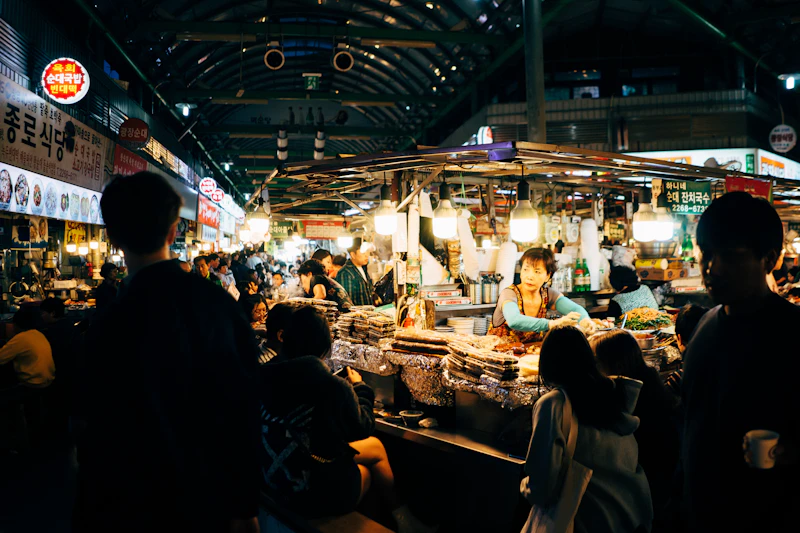
Korean food is, without exaggeration, one of the best reasons to visit the country. From sizzling Korean BBQ to steaming bowls of kimchi jjigae, the flavors are bold, complex, and endlessly satisfying. The best part? Eating in Korea is remarkably affordable. A full meal at a local restaurant typically costs 7,000-12,000 KRW ($5-$9), and street food snacks start from just 1,000 KRW ($0.75).
Must-Try Korean Dishes for Beginners
Korean BBQ (고기구이): Grilled meat at your table. Start with samgyeopsal (pork belly) or galbi (marinated short ribs). Wrap the meat in lettuce leaves with garlic, ssamjang sauce, and rice. Most BBQ restaurants require a minimum order of 2 servings.
Bibimbap (비빔밥): A colorful bowl of rice topped with vegetables, meat, egg, and spicy gochujang sauce. Mix everything together before eating. The stone pot version (dolsot bibimbap) comes sizzling hot and creates a crispy rice crust.
Kimchi Jjigae (김치찌개): Korea’s ultimate comfort food. A spicy, hearty stew made with aged kimchi, pork, and tofu. Served bubbling in a stone pot with rice on the side. Available everywhere for about 7,000-8,000 KRW.
Tteokbokki (떡볶이): Chewy rice cakes in a sweet-spicy red sauce. Korea’s most beloved street food. Found at nearly every market and street stall. Costs about 3,000-4,000 KRW for a generous portion.
Fried Chicken (치킨): Korean fried chicken is legendary — impossibly crispy, available in dozens of flavors (honey butter, soy garlic, spicy), and always paired with pickled radish and cold beer. Order through apps like Yogiyo or Baemin for delivery to your hotel.
Food Etiquette and Tips
| Topic | What to Know |
|---|---|
| Banchan (Side Dishes) | Every meal comes with free refillable side dishes (kimchi, pickled vegetables, etc.). Ask for refills by saying “banchan deo juseyo.” |
| Water | Free at every restaurant. Self-serve from water dispensers or coolers. No need to order bottled water. |
| Chopsticks | Korean chopsticks are metal and flat, which takes practice. Use the spoon for rice and soup. Never stick chopsticks upright in rice (this resembles funeral incense). |
| Dining Alone | Increasingly accepted, but some BBQ and hotpot restaurants require a minimum of 2 people. Look for places advertising “1인분 가능” (single portions available). |
| Vegetarian/Vegan | Challenging but improving. Many Korean dishes contain hidden meat or fish sauce. Learn “고기 빼주세요” (go-gi bbae-ju-se-yo = please remove the meat). Buddhist temple restaurants offer fully vegan meals. |
| Halal Food | Limited but growing. Itaewon in Seoul has the most halal restaurant options. The Korea Tourism Organization maintains a halal restaurant list. |
| Allergies | Sesame, soy, shellfish, and wheat are extremely common in Korean cooking. Use Papago to translate allergy cards. Most restaurants are accommodating when shown a written allergy notice. |
| Ordering | Many restaurants use touchscreen kiosks or QR code menus. Press the call button (벨) at your table for service — it is not rude, it is expected. |
Cultural Etiquette: What Every Visitor Should Know
Koreans are generally very understanding of foreign visitors making cultural mistakes, but knowing a few key customs shows respect and enhances your interactions. Here are the most important cultural norms to be aware of.
Shoes off indoors: Always remove your shoes when entering a Korean home, traditional restaurant (with floor seating), temple, or any place with a raised floor. Look for shoe racks or a pile of shoes at the entrance as your cue. Many accommodations, guesthouses, and some restaurants follow this custom. Wear socks without holes.
Bowing: A slight bow (15-30 degrees) is the standard greeting and sign of respect. You do not need to do a deep formal bow as a tourist, but a small head nod when greeting someone, saying thank you, or receiving something shows good manners. Koreans will appreciate the gesture even if your form is not perfect.
Two hands for giving and receiving: When handing something to someone (money, a business card, a gift) or receiving something, use both hands or support your right arm with your left hand. This is one of the most universally observed customs and applies at stores, restaurants, and in social settings.
Drinking etiquette: If dining with Koreans, never pour your own drink. Pour for others and they will pour for you. When an older person pours you a drink, hold your glass with both hands and turn slightly away from them when drinking as a sign of respect. These customs apply mainly to soju and beer at social dinners.
Subway etiquette: Do not sit in the priority seats (marked in a different color) even if the train is empty. Avoid talking loudly or taking phone calls on the subway. Eating on the subway is discouraged in most cities. Stand on the right side of escalators to let others pass on the left.
Temples and sacred spaces: Dress modestly when visiting temples (cover shoulders and knees). Remove hats indoors. Keep voices low. Ask before photographing monks or religious ceremonies. Many temples welcome visitors and even offer overnight temple stay programs.
Safety Tips for Traveling in South Korea
South Korea is consistently ranked among the safest countries in the world for travelers. Violent crime is extremely rare, public areas are well-lit and monitored, and the general attitude toward tourists is welcoming and helpful. That said, common travel sense still applies.
Emergency numbers: Dial 112 for police and 119 for fire/ambulance. The 1330 Korea Travel Hotline operates 24/7 with English, Japanese, Chinese, and other language support for travel emergencies and questions.
Health: Tap water is technically safe to drink, but most Koreans drink filtered or bottled water. Pharmacies (약국) are widespread and pharmacists can recommend over-the-counter medicines. If you need a hospital, major cities have international clinics with English-speaking doctors. Travel insurance is strongly recommended as healthcare costs for foreigners without insurance can be high.
Night safety: Korea is remarkably safe at night. Women traveling alone report feeling comfortable walking in most neighborhoods after dark. The extensive CCTV network, 24/7 convenience stores on nearly every block, and generally low crime rates contribute to this sense of security. Neighborhoods like Hongdae and Gangnam are bustling well past midnight.
Natural disasters: Korea experiences typhoons (August-September) and occasional earthquakes. Download the Safety Korea app for real-time emergency alerts in English. Heavy rain during monsoon season (late June-July) can cause flooding in low-lying areas.
Packing Essentials by Season
What you pack depends heavily on when you visit. Korea’s climate ranges from humid subtropical in the south to humid continental in the north, with dramatic temperature swings between seasons.
| Season | Temperature | Must-Pack Items |
|---|---|---|
| Spring (Mar-May) | 8-22 C (46-72 F) | Light layers, a medium jacket, comfortable walking shoes, allergy medicine (yellow dust season), sunscreen, umbrella for occasional showers. |
| Summer (Jun-Aug) | 25-35 C (77-95 F) | Lightweight breathable clothing, rain jacket or compact umbrella (monsoon season), sunscreen, mosquito repellent, portable fan, water bottle. |
| Autumn (Sep-Nov) | 10-25 C (50-77 F) | Layers (warm days, cool evenings), light jacket, comfortable shoes for hiking, camera for fall foliage, scarf for late November. |
| Winter (Dec-Feb) | -10 to 5 C (14-41 F) | Heavy insulated coat, thermal underwear, warm boots, gloves, hat, hand warmers (sold at every convenience store), lip balm for dry air. |
Universal packing tips: Bring a universal power adapter (Korea uses Type C and F plugs, 220V). Pack a small towel (some budget accommodations do not provide them). Bring any specific medications you need, as Korean pharmacies may not carry the same brands. Comfortable walking shoes are essential — you will walk 15,000-25,000 steps per day exploring Korean cities.
Common Scams and Mistakes to Avoid
Korea is exceptionally safe and scams are rare compared to many other tourist destinations. However, first-time visitors do fall into some common traps and make avoidable mistakes.
Overpriced airport taxis: Never accept rides from drivers soliciting passengers inside the airport terminal. Always use the official taxi stand outside or book through the Kakao T app. Legitimate taxis use meters. A ride from Incheon Airport to central Seoul should cost approximately 65,000-80,000 KRW by regular taxi.
Using Google Maps for navigation: This is the most common tourist mistake. Google Maps cannot provide accurate walking or driving directions in Korea. You will get lost. Use Naver Map instead. Download it before your trip and learn the basic interface.
Not carrying cash at traditional markets: While Korea is largely cashless, traditional markets like Namdaemun, Gwangjang, and Jagalchi are often cash-only. Carry at least 30,000-50,000 KRW when visiting markets.
Ignoring restaurant minimum orders: Many Korean BBQ and hotpot restaurants have a 2-person minimum order policy. Solo travelers should look for restaurants advertising single-portion options or visit food courts and gimbap shops instead.
Forgetting to validate your K-ETA: Arriving without a valid K-ETA can result in being denied boarding or facing delays at immigration. Apply at least 72 hours before your flight, though processing usually takes 24 hours or less.
Underestimating walking distances: Korean subway stations can be massive. What looks like a 2-minute walk on the map might take 15 minutes through underground corridors and transfers. Always add extra time for subway navigation, especially at major stations like Jongno 3-ga, Express Bus Terminal, or Gangnam.
Not checking restaurant hours: Many Korean restaurants close between lunch and dinner (roughly 2:30-5:00 PM). Plan your meals accordingly or stick to restaurants in tourist districts that serve continuously.
Plan Your Korea Trip: City Guides
Now that you have the essential korea travel tips for first time visitors, it is time to start planning your itinerary. Korea has incredible diversity packed into a relatively small country. Here are our detailed guides for the most popular destinations:
Seoul Travel Guide 2026 — The vibrant capital city with ancient palaces, K-pop culture, world-class shopping, and an endless food scene. Most first-time visitors spend 4-5 days here.
Busan Travel Guide 2026 — Korea’s stunning coastal city with beautiful beaches, the famous Gamcheon Culture Village, Jagalchi Fish Market, and a more relaxed vibe. A perfect 2-3 day addition to any Korea trip.
Jeju Island Travel Guide 2026 — A volcanic island paradise with unique landscapes, hiking trails, waterfalls, and a culture distinct from the mainland. Ideal for 3-4 days of nature exploration.
Book Your Korea Accommodation
Finding the right accommodation can make or break your Korea experience. From traditional hanok guesthouses to sleek modern hotels, Korea offers options for every budget and style.
Ready to book your Korea adventure?
Find the Best Korea Hotel Deals on Agoda
Compare prices on thousands of hotels, guesthouses, and hanok stays across Seoul, Busan, Jeju, and beyond. Free cancellation on most bookings.
Frequently Asked Questions
Is South Korea safe for solo female travelers?
Yes, South Korea is one of the safest countries in the world for solo female travelers. Violent crime rates are extremely low, public transportation runs late into the night, streets are well-lit with extensive CCTV coverage, and 24/7 convenience stores provide safe havens on virtually every block. The 1330 Korea Travel Hotline offers 24/7 multilingual assistance for any emergencies. Common-sense precautions still apply, but women traveling alone consistently report feeling safe throughout the country, even in the late evening hours.
How much money do I need per day in South Korea?
Budget travelers can comfortably get by on 60,000-80,000 KRW ($45-$60 USD) per day, covering hostel accommodation, public transit, street food, and local restaurant meals. Mid-range travelers typically spend 150,000-250,000 KRW ($110-$185) per day, which includes a comfortable hotel, a mix of restaurant dining and Korean BBQ, subway and occasional taxis, and attraction entry fees. Korea offers excellent value for money compared to Japan and other developed Asian countries, and food in particular is remarkably affordable.
Do I need to speak Korean to travel in South Korea?
No, you do not need to speak Korean to travel in South Korea. Major tourist areas, subway systems, and airports have English signage. However, English is not widely spoken by the general population outside of tourist districts and younger generations. The Papago translation app is essential and far more accurate for Korean than Google Translate. Learning basic phrases like “hello” (annyeonghaseyo), “thank you” (gamsahamnida), and “how much” (eolmayeyo) will greatly enhance your experience and is always appreciated by locals.
What is the best time of year to visit South Korea?
Spring (April-May) and autumn (September-November) are the best times to visit South Korea. Spring brings cherry blossoms, comfortable temperatures around 15-22 C (59-72 F), and clear skies. Autumn offers spectacular fall foliage, cool pleasant weather, and numerous harvest festivals. Summer (June-August) is hot and humid with monsoon rains, while winter (December-February) brings sub-zero temperatures but is ideal for skiing and enjoying Korea’s cozy indoor culture, including jjimjilbangs (Korean spas) and piping hot stews.
Can I use my credit card everywhere in South Korea?
South Korea is one of the most cashless societies in the world, and Visa and Mastercard are accepted at the vast majority of stores, restaurants, cafes, and convenience stores. However, you should carry some cash (at least 50,000 KRW) for traditional markets, small street food vendors, some temple entrance fees, and older neighborhood shops. ATMs that accept international cards are available at every convenience store (GS25, CU, 7-Eleven) — look for machines labeled “Global ATM.” Tipping is not customary and not expected anywhere in Korea.
Why does Google Maps not work properly in South Korea?
Google Maps cannot provide accurate turn-by-turn navigation, walking directions, or transit routing in South Korea due to government restrictions on exporting detailed mapping data. This is related to national security concerns stemming from Korea’s proximity to North Korea. Instead, download Naver Map, which is the most reliable navigation app in Korea with accurate walking routes, real-time bus arrivals, subway transfers, and even interior maps of shopping malls. Kakao Map is another good alternative. This is arguably the most important tech tip for visiting Korea.